
Stage Cave Diving Training: Why It Changed the Way I Think About the Cave

Stage cave divers swimming into the cave for a training dive
There's a moment on every cave dive when you reach your gas pressure limit and have to turn the dive. Sure you can train your cardiovascular health, practice yoga or freediving for better breathing techniques, and streamline your gear for maximum efficiency in the water. But you will always come up to your gas limit. Stage cave diving adds additional tanks, so that you can pass that two tank limit and see more of the cave.
What "Stage" Actually Means
What do we actually mean by stage cave diving? A stage cylinder is an additional tank (or tanks) - typically an aluminium 80 - carried during the penetration phase of a dive. You breathe it down to a predetermined amount, ‘stage’ it clipped off to on the line, and continue on your back-gas. On the way out, you pick it up again and use the remaining gas to support a safe exit.
Simple in concept. Demanding in execution.
The beauty and the discipline of stage diving gives you the same thing: more gas - or time to spend in the cave. Whether this is to extend bottom times at a deeper site, to extend the distances you can travel, or just do one long dive in the water stages change the way you cave dive.

Picking up a stage tank during training
How I First Started Stage Cave Diving
I came to stage diving in Mexico, previously I had done quite some cave diving in Australia in Mount Gambier, this was at the equivalent of Intro To Cave level. Following Full Cave Training in Mexico in 2014, I was even more deeply hooked on cave diving. I was curious about stages and how they can be used - clearly in Mexico with the length of the caves here stage cave diving can open up more cave for diving compared to the smaller caves I had seen in Australia. Following my Full Cave TrainingI spent a few months living in Playa del Carmen and cave diving as much as I could. I was already starting to push against the limits of what my back-gas would allow.
When I arrived in Mexico to live in 2016 and started doing serious cave diving in the Yucatán, the context changed dramatically. The cave systems here like Sistema Sac Actun, Ox Bel Ha, and the emerging systems I am exploring around Tulum are the longest submerged caves on the planet. They demand stage tank gas if you want to go anywhere meaningful for exploration. Back-gas will get you a beautiful dive. A stage will get you somewhere no one has been before, or least much further in than you would have seen with two tanks.
That's the draw!

Choosing a good drop location for the stage tanks
What Stage Cave Diving Training Actually Involves
My Stage Cave Diver course runs over several days and it is not a course I rush. By the time a student sits in front of me for stage training, they need to be a genuinely comfortable, competent full cave diver. Stage introduces a layer of task loading and gas complexity that will expose any weakness in buoyancy, trim, propulsion, or situational awareness. I'd rather a student be over-prepared than technically qualified but not truly ready. There is no need to rush!
The early confined water sessions focus on configuration and skills. Handling a stage cylinder in a cave is not like diving with a deco tank in open water, like you would as an Advanced Nitrox and Decompression Procedures diver. You're moving through a passage, navigating a line, monitoring gas, reading the environment, and communicating with a buddy so the tank needs to be comfortable and a part of your profile you are aware of. The stage has to become an extension of you, not an obstacle strapped to your side.Too often stages can hang low, impacting the floor, dragging through silt or damaging stalagmites.
We spend real time on:
The drop and the pick-up. Leaving a stage at a specific point on the line, and retrieving it smoothly on exit sounds easy. Doing this while maintaining buoyancy, position and contact with the team in a busy passage with a silty bottom or low visibility, it's anything but. We practice this scenario repeatedly, including in reduced visibility conditions.
Gas planning. With stage gas, the mathematics shifts. You might not be simply splitting one tank into three portions. You're managing your separate gas supplies, each with its own limits, and integrating them into a coherent dive plan. Students learn to plan using a variety of gas strategies to make the most of the stage tanks.
Valve management and gas problems. One of the more confronting parts of stage training: what happens when you or your team mate runs low on gas, or has a problem with a regulator? We practice managing gas failures with visibility and without until it's reflexive — because in the cave, there's no time to think. There's only time to act.
Moving with stages. Stage cylinders change your profile. You're wider (or taller). You have to think about your team differently — spacing, positioning. We work through the discipline of moving as a unit without touching the walls, the ceiling, or the line.

Stage cave diving training in open water, stowing the stage regulator for the drop.
The Mindset Shift
The technical skills of stage diving are learnable. What takes longer, and what I think separates the great cave divers from the competent ones, is the mental discipline it requires.
When you cave dive, your dive plan is a contract. You turn at the gas you planned to turn at. Full stop. The cave will be there on the next dive, and the dive after that. The Yucatán Peninsula is full of passage more than any of us will dive in a lifetime. There is absolutely no reason to push your gas limits.
At the same time, because many of the caves are shallow, diving with stages allows for really long dive times. This can put divers past their comfort zone for distance from the entrance. The feeling of being a 90 minute swim back to open water can be stressful. Once that feeling of discomfort sinks in, it is time to turn the dive and go home. So building up to longer dives, and being comfortable turning when feeling distance is something I emphasize.
Another consideration is that as dives get longer they become more mentally taxing. You need to keep the constant mental attention required for safe cave diving during the whole dive. Monitoring gas, checking the presence of the team, positioning to move through the best place in the tunnel, and awareness of navigation does not switch off because we are on the way out of the cave. Indeed, this is where we need to be most switched on, as a navigation error like swimming past a T intersection could leave the team on a line leading into, not out of, of the cave.
Stage training is, at its core, training for the mental discipline to say no to yourself in a beautiful place and the opportunity to build up confidence and comfort further and further away from the entrance.
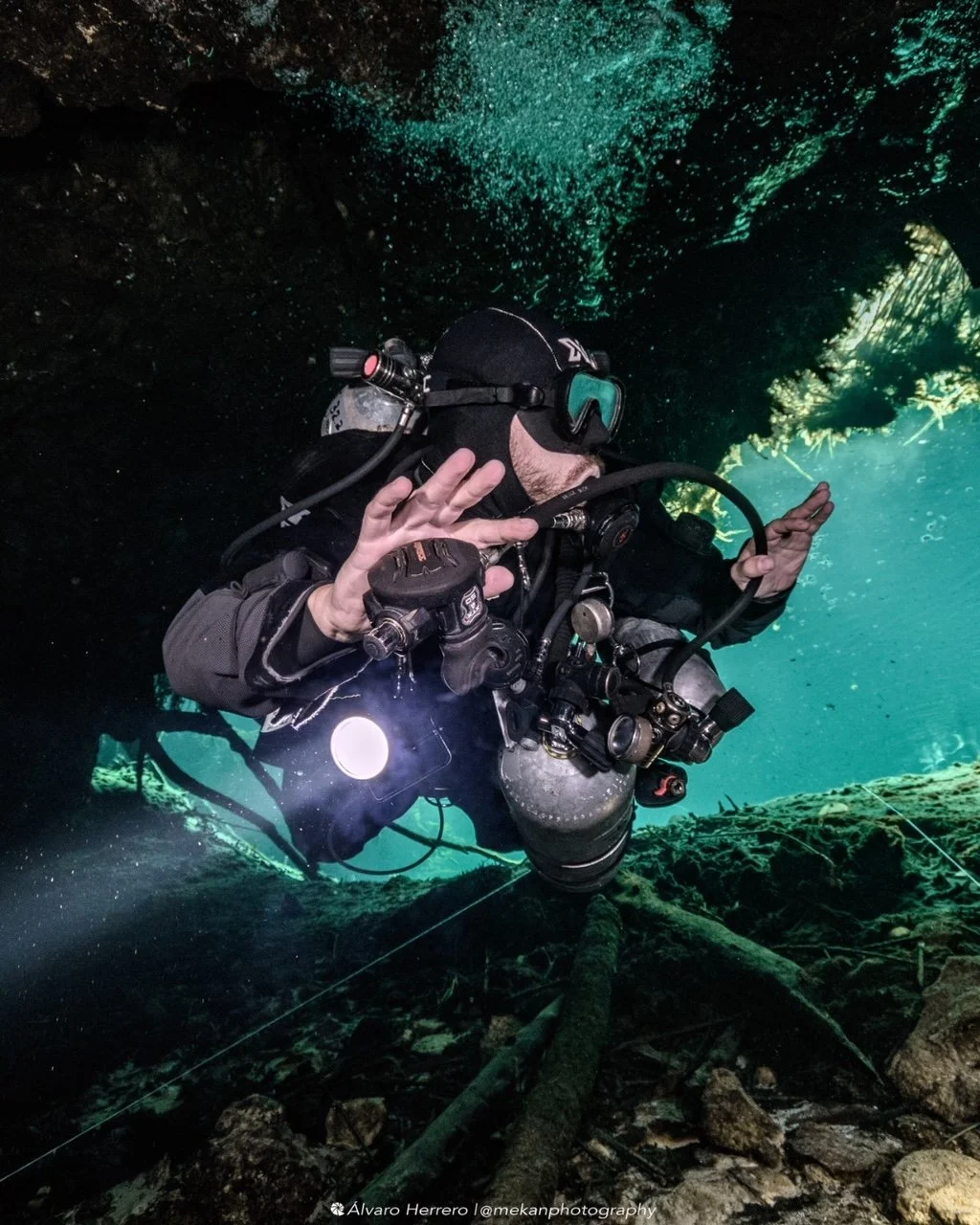
Cave diver switching to their stage tank
Why I Love Teaching Stage Cave Diving
Stage cave is one of my favourite courses to teach, because we get to do longer dives, further away from the entrance. As the dives get longer, it gives me more time to create the scenarios and problem solving on the exit portion of the dive.
There's a particular moment, usually on day two or three, when a student stops fighting the stage cylinder and starts thinking about it. The cylinder stops being an extra thing they're managing and becomes part of how they're reading the dive. When I see that shift, I know we're getting somewhere real.
I work in one-on-one or very small group settings specifically so I can see that moment and build on it. Every diver learns differently, processes differently, gets stuck differently. Stage training amplifies those differences in useful ways: it shows me exactly where each student needs more time, more repetition, more conversation.
We're fortunate here in Tulum to have cave systems that are almost pedagogically designed for this progression. There are passages that require stage to access meaningfully. There are sites where the training conditions are ideal with clear water, good navigation options, manageable depth, and sites where we can push the student's skills in a controlled but genuinely demanding environment. I don't believe in classroom-heavy cave training, sure we need to spend some time and the theory side of things is important. But I believe in getting in the water and spending as much time training as we can.

Using stage tanks to see more of the Ox Bel Ha system!
Is Stage Training Right for You?
If you hold a Full Cave certification and you've been logging dives steadily, not ticking a box but actually building experience, stage cave is a logical and enormously rewarding next step. It builds on your full cave skills, allows you to review and refresh them, and introduces the stage skill. It's also excellent preparation and requirement for courses like cave decompression, and cave DPV, all of which involve similar gas management, complexity, and mental awareness.
What I ask of students before we start: be honest with yourself about your current level. Come to me when you feel genuinely settled in your full cave skills, and we'll build from there.
If you're unsure where you stand, reach out. I'm happy to talk through your dive history, your goals, and whether a mentoring day or some supervised cave dives might help you consolidate before the course.

Stage cave diving training in open water, stowing the regulator for the drop
Frequently Asked Questions
"What certification do I need before stage cave diving?"
You need to be a Full Cave Diver with some experience, I would suggest 50 full cave dives.
"How long does a stage cave course take?
The Stage Cave Diver Course takes 4 days. Like all of my training, this depends on the level you come in at and how the training progresses.
"What equipment do I need for stage cave diving?"
You will need a stage regulator (or can borrow one of mine for the course) as well as stage rigging. During the training we will test different stage rigging options so you can choose the one which suits you best.
"What is the difference between a stage tank and a deco tank?"
When we use stage tanks it is to increase the amount of gas we can use to go further into the cave. Whereas when we use a deco tank it is to reduce the amount of decompression obligation we have.
Ready to start Stage Cave Training?
